
How to price resold SEO services without confusing markup and margin
If you buy a service for £1,250 and sell it for £2,500, you have a £1,250 spread before your own costs. You have not made £1,250 net profit. This distinction matters when you hire account managers, absorb long client calls or pay to win the account.
This guide uses SEORUK’s four monthly link-building packages to build a pricing worksheet you can actually use. The suggested resale prices are examples, not mandatory prices or promises of profitability.
Build a price that works
Supplier cost
Your SEORUK package
Agency costs
Time and overheads
Client fee
Price for your scope
1. Start with the supplier price and the exact scope
Price a defined service, not the phrase “SEO”. A link-building budget, a technical audit and a managed SEO retainer are different purchases. Giving them the same label makes comparisons difficult and encourages scope creep.
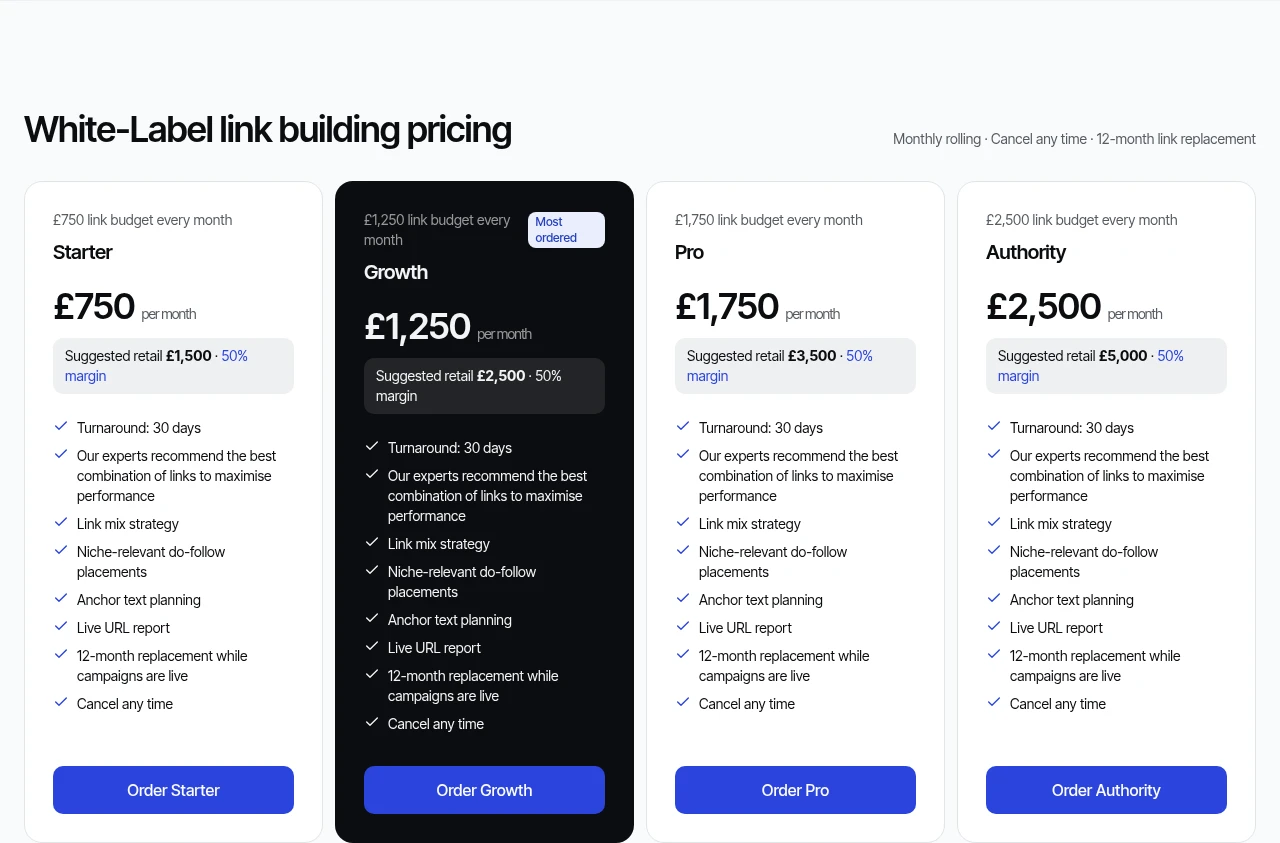
For SEORUK link building, the four monthly packages are Starter at £750, Growth at £1,250, Pro at £1,750 and Authority at £2,500. Our experts recommend the mix of links for the campaign. The fee does not buy a fixed number of links, a specified DR tier or a guaranteed position.
Read the current link-building service page before quoting. These prices were checked on 30 October 2026 and exclude VAT. They are monthly recurring prices, not one-off fees. If your client needs content, technical work or broader management, identify those services separately instead of quietly including them in the same figure.
Write a short internal scope statement: “Monthly link-building fulfilment, plus the agency management tasks listed below.” If you cannot finish that sentence precisely, you are not ready to price it.
2. Calculate markup and gross margin correctly
Markup measures the increase over cost. Gross margin measures the spread as a proportion of the selling price. They use different denominators.
- Markup = (client price minus supplier cost) divided by supplier cost.
- Gross margin before agency costs = (client price minus supplier cost) divided by client price.
At a 2x client price, the markup is 100% and the gross margin before agency costs is 50%. Calling this “100% profit” is wrong. It ignores both the selling-price denominator and your operating costs.
| Package | Monthly supplier cost | Suggested 2x client price | Spread before agency costs | Gross margin before agency costs |
|---|---|---|---|---|
| Starter | £750 | £1,500 | £750 | 50% |
| Growth | £1,250 | £2,500 | £1,250 | 50% |
| Pro | £1,750 | £3,500 | £1,750 | 50% |
| Authority | £2,500 | £5,000 | £2,500 | 50% |
This table does not establish what a customer will pay. It gives you a starting calculation. Your market, client scope, service quality and relationship still matter. If the agreed client price is lower, calculate the consequences before accepting the account.
3. Put a realistic cost against your agency’s time
Include discovery, proposal preparation, briefing, delivery review, meetings, reporting and support. Account management is real work, even when your supplier handles fulfilment.
Use an internal hourly cost based on your business, not the hourly price you charge clients. Salary, employer costs and overhead allocations can affect that figure. A founder doing the work personally still has a time cost; it is not free because no invoice changes hands.
Here is a hypothetical Growth account. All figures are planning assumptions and exclude VAT:
| Monthly item | Example amount |
|---|---|
| Client revenue | £2,500 |
| SEORUK Growth cost | £1,250 |
| Four hours of account work at an assumed £50 internal hourly cost | £200 |
| Assumed payment, software and administration allowance | £100 |
| Contribution after these listed costs | £950 |
That is a 38% contribution on the example revenue, not net profit. It still excludes costs such as acquisition, business-wide overheads and tax unless you have included them in your allowances. The four hours, £50 rate and £100 allowance are not SEORUK fees or benchmarks. Replace them with your own figures.
Then run a difficult-month scenario. If the account takes ten hours rather than four, that extra £300 reduces the example contribution to £650. The package has not changed; your cost to manage the client has. A pricing worksheet should expose that risk before you quote.
Where £2,500 goes
Hypothetical Growth account, monthly and excluding VAT
£1,250
SEORUK Growth
Supplier fulfilment
£200
Account work
4 hours at an assumed £50/hour
£100
Allowances
Assumed payment, software and admin costs
£950
Contribution
38% of revenue, not net profit
Time and allowances are planning assumptions, not SEORUK fees. Acquisition costs, other overheads and tax are not included.
4. Include acquisition and setup costs without hiding them
An account may take several hours to win and onboard. Decide whether you recover that cost through a separately described setup fee, a sustainable ongoing price or your sales budget. Do not invent a SEORUK setup charge that the product does not have.
If you recover acquisition cost across expected months, use a conservative assumption and label it. A customer who can cancel should not be modelled as guaranteed twelve-month revenue. For example, allocating a hypothetical £600 acquisition cost across six months adds £100 a month to your internal model, but it does not mean the customer has committed to six months.
SEORUK link packages can be cancelled any time, with cancellation at the end of the paid period. Your own client agreement is separate. Any notice period, agency setup fee or service management commitment must be explicit and should not be presented as a supplier requirement.
Avoid using a headline discount to win an account unless you know which cost it reduces or which task you can remove. Cutting revenue while leaving every obligation unchanged usually cuts your contribution instead.
5. Handle VAT separately from revenue
The examples in this guide are excluding VAT. SEORUK adds 20% VAT for UK buyers at checkout. Growth therefore has a £1,250 base price and a £1,500 UK checkout total including £250 VAT.
Do not treat VAT collected as agency revenue or assume that every agency can reclaim VAT on purchases. Your registration, customer location and accounting circumstances matter. If input VAT is not recoverable, that changes your effective cost and the simple ex-VAT spread may overstate your position.
For a UK VAT-registered agency charging 20% on a hypothetical £2,500 client fee, the invoice total would be £3,000. The £500 VAT is not additional sales income in the contribution model. Confirm your own invoicing treatment with an accountant, particularly for cross-border clients.
This is a pricing explanation, not tax advice. Keep ex-VAT and VAT-inclusive figures clearly labelled in proposals so a buyer can see the actual amount they will pay.
6. Price the agency work as well as fulfilment
Two agencies buying the same package may reasonably charge different client prices. One may provide a monthly meeting and report review. Another may coordinate content, development and conversion tracking. Those responsibilities have different costs.
List your obligations before setting the price. A simple client-facing structure is:
- Monthly link-building fulfilment under the agreed package.
- The destination pages and campaign priorities covered.
- The agency’s briefing, review and client communication responsibilities.
- Meeting frequency and how additional work is agreed.
- What is excluded from this fee.
- Recurring billing, cancellation and replacement conditions.
Do not quietly promise unlimited consulting or website changes because the client price is higher than the supplier price. Write down what the difference pays for. If content is needed, discuss blog writing or website copywriting as a distinct scope rather than assuming link fulfilment includes it.
7. Use a minimum-price worksheet
For each prospective account, fill in supplier cost, monthly agency time, internal hourly cost, payment and tool allowances, acquisition allocation and desired contribution. The minimum client price is the total listed costs plus the contribution you need.
If you want a contribution equal to a chosen percentage of revenue, divide the total costs by one minus that percentage expressed as a decimal. With hypothetical total costs of £1,550 and a 40% target contribution, the model price is £1,550 divided by 0.60, or £2,583.33. This is arithmetic for planning, not a recommended SEORUK price.
Test your number against the actual proposal. Can the client see why the scope is worth that fee? Can you deliver the agency tasks at the assumed time cost? If not, change the scope or decline the account. A spreadsheet cannot make a poor-fit client profitable.
Read how to choose a link-building package next, or return to the reseller starting guide if you are still defining your offer.
FAQs
Does a 2x resale price mean a 100% margin?
+
Can I charge more or less than the suggested retail price?
+
Is VAT included in the table?
+
Are Starter and Growth complete SEO management packages?
+
Sources and further reading
- SEORUK’s published link-building catalogue, checked on 30 October 2026.
- Backlinko: How to sell SEO services, for connecting the proposal to the prospect’s problem rather than selling a tool score.
- All worked cost models are hypothetical. No market-average profit, guaranteed client price or customer result is claimed.
Ready to put your name on it?
Order in minutes, brief us instantly, and track fulfilment in your branded partner portal.
Start an order