
How to choose a link-building package to resell
Choose a link-building package around a client’s pages, campaign readiness and sustainable budget. Do not choose it because the name sounds impressive or because a competing site has a higher authority score.
SEORUK has four monthly link-building budgets: Starter, Growth, Pro and Authority. This guide explains what changes between them, what does not and which questions to answer before recommending one. It also covers the search-policy questions an agency should discuss openly with its provider and client.
1. Check that link building is the right next step
A budget decision comes after a diagnosis. Start with the pages the client wants to support. Can search engines access them? Do they answer the relevant query? Do they offer enough useful information for a visitor to take the next step?
If a page is thin, out of date or aimed at the wrong customer, more links may not resolve the problem. If a site has a technical indexing issue, deal with that first. An SEO audit or website copywriting may be a more useful purchase than a link budget.
Next, look at the search results for the actual queries the client cares about. Identify the kind of page that ranks, the intent it serves and the businesses competing for attention. A national product category and a local service enquiry are not the same campaign.
Ask for access to reliable performance data where available. Record the pages, date range and conversion measures before making recommendations. If access is missing, say which decisions are provisional rather than filling the gap with confident assumptions.
2. Compare the four budgets without inventing deliverables
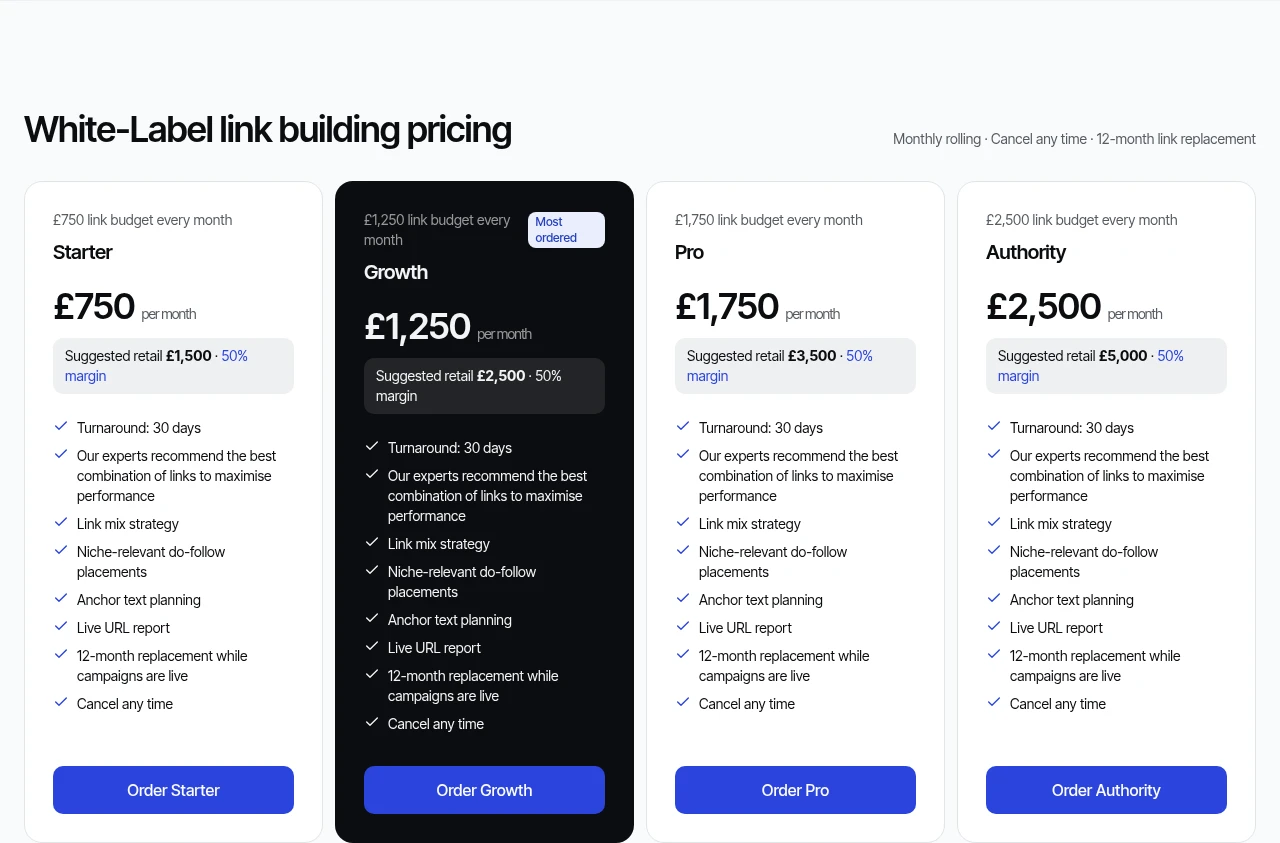
| Package | Monthly agency price | Suggested monthly client price | The budget decision |
|---|---|---|---|
| Starter | £750 | £1,500 | Lowest available recurring link budget |
| Growth | £1,250 | £2,500 | £500 more supplier budget than Starter |
| Pro | £1,750 | £3,500 | £500 more supplier budget than Growth |
| Authority | £2,500 | £5,000 | Highest of the four available budgets |
Prices were checked on 30 October 2026 and exclude VAT. Client prices are suggested 2x examples, not compulsory charges. SEORUK charges UK buyers 20% VAT at checkout. Check the current service page before quoting.
All four packages use an expert-recommended link mix. The shared published scope includes link mix strategy, anchor text planning and a live URL report. A larger budget is not a promise of a particular number of placements, a particular DR score or faster rankings. Do not add those commitments to your sales sheet.
The packages are recurring monthly only, with cancellation at the end of the paid period when requested. Free replacement for a dropped link applies within 12 months of placement and only while the client has live campaigns with SEORUK. Make that condition clear when discussing the offer.
3. Choose a budget the client can sustain
Do not start with the most expensive tier and work backwards from an objection. Work forwards from the client’s circumstances. Is there a defined campaign objective? Are the supporting pages ready? Is there budget for necessary content and technical work as well as links?
A fictional specialist consultancy might choose Starter while it concentrates on a small set of ready service pages. A different business with a wider agreed campaign and a sustainable budget might consider Growth or Pro. Authority may be appropriate when the highest budget fits the researched plan, not simply because the client has a large website.
Those are decision examples, not eligibility rules or predicted outcomes. No tier is automatically suitable for a particular industry, website size or revenue level. Discuss the proposed pages and market with SEORUK before promising how the budget will be allocated.
Keep room in the client’s overall plan for implementation and measurement. Spending every available pound on links while leaving critical pages unfinished is not a coherent SEO strategy. If the client needs broader ongoing delivery, compare managed SEO rather than pretending the link package already covers it.
Before you choose a link budget
- 1
Is the target page ready?
If it cannot be indexed or does not answer the search, address technical or content issues first.
- 2
Is the campaign goal clear?
Name the priority pages and commercial objective before choosing a tier.
- 3
Can the client sustain the budget?
Allow for agency account work as well as the monthly supplier cost.
- 4
Discuss the suitable package
Starter, Growth, Pro and Authority are budgets, not promises of link counts or rankings.
4. Ask what the provider’s quality process actually checks
Ask for an example report and discuss relevance, editorial context, placement transparency and the checks carried out before delivery. A single headline metric is not a substitute for examining the page and site.
Ahrefs’ link-building guide discusses the relevance and authority of linking pages. Use it as background for due diligence, not a formula that turns a score into a guaranteed outcome. Third-party metrics are not Google’s ranking scores.
A useful provider conversation includes these questions:
- What information is needed to recommend the campaign’s link mix?
- How are the destination pages and anchor suggestions reviewed?
- What does the report show for each live placement?
- Which parts of the plan require approval before delivery?
- What happens if a placement is delayed or a delivered link disappears?
- How are paid placements identified and link attributes handled?
These are questions to verify, not claims that every approval or monitoring feature already exists in SEORUK. If a particular client requires pre-approval of each placement, ask whether that is supported before putting it in their contract.
5. Discuss Google’s link policies plainly
This is not optional fine print. Google’s spam policies describe buying or selling links for ranking purposes as link spam. Google’s outbound-link qualification guidance recommends rel="sponsored" for advertisements and paid placements; nofollow remains acceptable.
SEORUK’s current catalogue advertises do-follow placements. That description does not make a paid placement compliant with Google’s policies. An agency should clarify the nature of placements, qualification and the associated risks before buying or reselling them. If a client requires policy-compliant sponsored attributes, obtain explicit confirmation of the supported approach.
Do not describe paid links as Google-approved, risk-free or guaranteed to improve rankings. Google says policy violations may lead to lower rankings or exclusion from results. No agency can promise that a particular tactic is immune from that risk.
This does not mean you should make dramatic penalty predictions. It means the client deserves an accurate description of the work and its limitations. Distinguish earned editorial coverage, paid advertising and links acquired to influence rankings in your discussion.
6. Prepare a useful brief, not a long keyword wish list
For each destination page, provide its URL, relevant keywords, anchor preferences and the audience it serves. Identify brand terms, restricted wording and any pages that should not be promoted. Explain the priority rather than assuming that listing a page makes it a priority.
SEORUK accepts up to 75 page entries per order. This supports multi-page briefing; it is not a link count. If the budget is focused, choose priorities instead of dividing attention across every page on a large site.
The detailed brief follows payment. Prepare the information in advance, then add it to the correct order and client. Keep changes in the order’s communication trail so delivery staff are not working from conflicting email versions.
If the client changes a URL, removes a page or rewrites its purpose after the brief, flag that promptly. A campaign aimed at an obsolete page is avoidable waste. Your agency owns the responsibility for accurate, current instructions.
7. Review outputs and outcomes separately
When work arrives, check the live URL report against the agreed scope. A placement being live is not evidence that it generated a ranking change. Keep reporting of fulfilment separate from interpretation of performance.
Compare agreed search and conversion indicators over consistent date ranges. Note other changes to the site and market. If rankings move, explain what you observed and what remains uncertain. Do not credit one link with a sale without evidence connecting them.
If the budget needs to change, use the current evidence and the client’s ability to sustain it. SEORUK plan changes apply from the next renewal, without proration. Do not tell a client that buying a higher package changes the current month’s completed work automatically.
Before sending your proposal, read the reseller pricing worksheet and how to pitch SEO to existing clients. The right package can still become a bad account if its costs and expectations are poorly explained.
FAQs
How many links does each package include?
+
Does Authority guarantee stronger rankings than Starter?
+
Is link replacement unconditional?
+
Are paid do-follow links risk-free?
+
Sources and further reading
- Ahrefs: Link building for SEO.
- Google: Spam policies for Google web search.
- Google: Qualify outbound links.
- SEORUK catalogue and billing terms, checked on 30 October 2026. Fictional scenarios are decision examples, not client case studies.
Ready to put your name on it?
Order in minutes, brief us instantly, and track fulfilment in your branded partner portal.
Start an order