How to pitch SEO to existing clients without promising rankings
An existing client does not need a lecture on why SEO matters. They need a reason to discuss a specific business problem and enough evidence to decide whether the proposed work is worth funding.
This guide gives you a discovery structure, a permission-based outreach message and a proposal outline for reselling SEORUK services. It uses the four monthly link-building packages where they fit, but it does not assume that every client needs links. All example businesses and conversations are fictional.
Turn an observation into a proposal
Find the problem
Start with evidence
Explain the work
Make the scope clear
Agree the plan
Set the next review
1. Choose the client before you choose the pitch
Look for a client whose business you understand and whose website has a problem you can investigate. A client already asking about missed enquiries or a new service launch is a better starting point than a list of everyone who has ever paid your agency.
Check whether the business can benefit from additional qualified demand. Ask about capacity, conversion handling and the services it wants to grow. A full appointment book or an unresponsive sales process changes the business case.
Also consider trust and access. Can you review the relevant pages? Is the client willing to share search data? Who controls the site and approves changes? If those basics are missing, your first conversation should establish them rather than end with a package recommendation.
Write down the reason for contacting this person now. “We have a new reseller service” is your reason, not necessarily theirs. “You mentioned wanting more enquiries for the new commercial service” gives the conversation a business context.
2. Bring one observation you can support
Find a concrete issue on a relevant page or in authorised search data. It might be a service page that does not explain the offer, an indexing problem or a mismatch between the searches attracting visitors and the enquiries the client wants.
Do not invent a revenue loss by multiplying a keyword-tool estimate by a conversion rate you have never measured. Search volumes are estimates, and a search is not a visit or a sale. If you lack analytics access, say that you have an observation to investigate, not a completed diagnosis.
Backlinko’s SEO sales guide emphasises preparation and demonstrating value before the sale. Apply that approach using your own review of the client’s site. Avoid borrowing its author’s reported close rate as a benchmark for your agency.
A good opening observation is narrow: “Your new service page explains the process, but it does not answer the location-specific questions you said prospects ask.” A poor one is sweeping: “Your competitors are stealing all your traffic.” The first can be checked and discussed. The second usually cannot.
3. Ask permission for the conversation
Use the client’s preferred communication channel and keep the message short. Respect their preferences and applicable marketing requirements. An existing commercial relationship is not a reason to ignore consent or send repeated unsolicited pitches.
Here is a hypothetical message you can adapt:
You mentioned wanting more enquiries for the commercial property service. I reviewed the main page and found a couple of points worth checking against your search data. Would you like a short call to look at them? If there is a sensible next step, I can outline the work and cost. If not, I will say so.
It names the client’s goal, offers a limited discussion and avoids promising a result before the review. Do not claim to have completed an audit if you only looked at one page. Do not call a paid service free because the first conversation is free.
For existing accounts, a scheduled review meeting may be more appropriate than a separate sales message. Put the observation on the agenda and let the client decide whether to explore it. A useful account conversation can produce a decision to postpone work as well as a sale.
4. Run a discovery call before presenting tiers
Use the call to establish the commercial aim, the current evidence and the practical constraints. Avoid spending the first ten minutes explaining tools while the client wonders what you are proposing.
Ask these questions in plain language:
- Which services or products should bring in more enquiries?
- What makes an enquiry useful rather than merely numerous?
- Which customers and locations are the priority?
- What has already been tried, and what can we verify about it?
- Who can approve and implement website changes?
- What monthly budget is sustainable alongside other marketing work?
- What would make the next review useful for the client?
Confirm the answers back before recommending anything. If the client asks for first position next month, explain that you can commit to work and reporting, not a ranking. If they want a price immediately, give a clearly labelled package range while making the recommendation conditional on the review.
5. Match the service to the finding
If the site has technical obstacles, discuss a white-label SEO audit. If the client needs ongoing strategy, content and on-page work, compare managed SEO. If location visibility is the issue, consider local SEO.
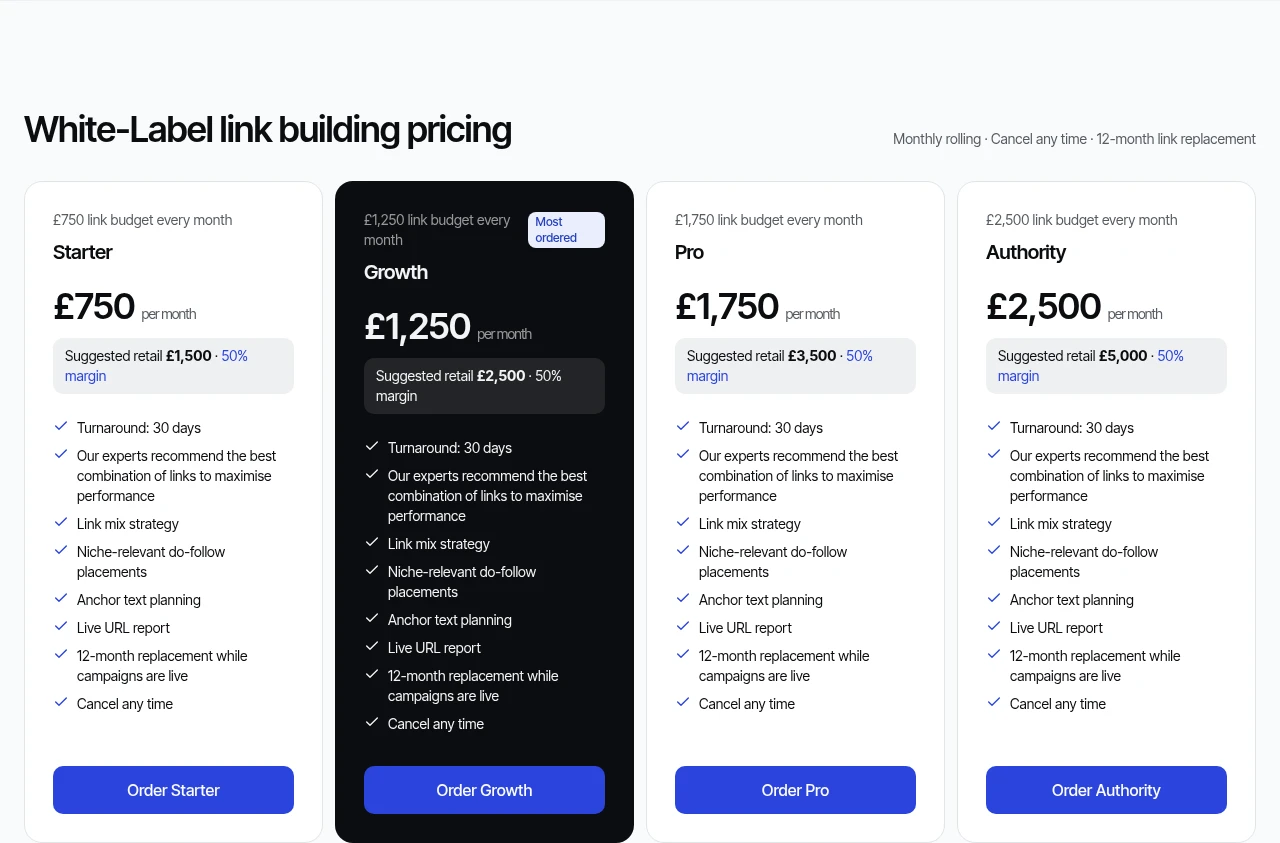
Use link building when the researched plan supports it and the target pages are ready. The four package budgets are:
| Package | Monthly agency price | Suggested monthly client price |
|---|---|---|
| Starter | £750 | £1,500 |
| Growth | £1,250 | £2,500 |
| Pro | £1,750 | £3,500 |
| Authority | £2,500 | £5,000 |
Prices were checked on 30 October 2026 and exclude VAT. SEORUK charges UK buyers 20% VAT at checkout. Suggested retail is 2x and is not compulsory. The packages provide an expert-recommended link mix, not fixed link counts or guaranteed rankings. A higher budget is not a substitute for a suitable campaign.
For a fictional consultancy with ready service pages and a sustainable supplier budget of £1,250, Growth could be considered. At the suggested £2,500 client price, the £1,250 spread funds your agency costs and potential contribution. It is not net profit. Explain what agency management is included rather than presenting the spread as money earned for doing nothing.
6. Write a proposal that can survive the first review
Keep the proposal specific enough that both parties can tell whether the agreed work has been delivered. Include the objective, current evidence, recommended service, supported pages, agency responsibilities and exclusions.
A usable outline is:
- Objective: the client’s agreed business problem.
- Starting evidence: the observations and authorised data reviewed.
- Recommended work: the purchased service and why it fits.
- Agency contribution: briefing, review, meetings and reporting.
- Commercial terms: fee, VAT treatment, recurring billing and cancellation.
- Limitations: outcomes are not guaranteed and link-policy risks are disclosed.
- Review: what will be measured, over which date ranges and when discussed.
For link packages, explain that cancellation takes effect at the end of the paid period. Dropped-link replacement applies within 12 months of placement only while the client has live campaigns with SEORUK. Do not promise free replacement after the client has stopped running campaigns.
Paid placements also need an honest policy discussion. Google’s spam policies address buying links to manipulate rankings, and its qualification guidance recommends sponsored attributes for paid placements. Confirm the proposed approach with SEORUK and do not describe it as Google-approved or risk-free.
A proposal the client can understand
What is the problem?
Evidence and objective
A supported observation and a measurable commercial goal
Who does what?
Work and ownership
Supplier scope, agency contribution and implementation owner
What does it cost?
Commercial terms
Monthly fees, VAT and clearly stated cancellation terms
What happens next?
Limits and review
No ranking guarantees; agree the baseline and review method
7. Answer objections without manufacturing urgency
When the client says “we tried SEO before”, ask what was bought, what changed and how it was measured. Do not dismiss the previous provider without evidence. Use the answer to clarify what will be different in this scope, if anything.
When the client says “that is expensive”, ask whether the concern is affordability, unclear work or an uncertain business case. Reducing the price does not answer all three. You might propose a smaller appropriate scope, improve the explanation or recommend postponing the purchase.
When the client says “can you guarantee results?”, separate deliverables from outcomes. You can commit to the agreed service and management tasks. You cannot guarantee a particular ranking, enquiry count or revenue level. Replacement terms apply to links, not commercial performance.
Avoid fake deadlines, invented scarcity and unverified claims about agency numbers. The next step can be simple: permission to review data, approval of a defined proposal or a discussion with SEORUK. Pressure is not a substitute for a clear recommendation.
8. Make the handover easy after agreement
Prepare the destination URLs, keywords, anchor preferences and campaign constraints with the client. SEORUK takes payment before the detailed intake. Once payment is complete, submit the brief against the right client and order in the agency portal.
Check the client-facing report and branding before sharing delivery. In the review conversation, separate completed work from observed search performance and from business outcomes. Keep a record of other website and marketing changes so you do not attribute every movement to one service.
If the client is not ready, agree whether and when to revisit the issue rather than chasing indefinitely. A credible recommendation sometimes ends with no purchase. That can preserve the relationship for work that genuinely fits later.
Next, use the pricing guide to check your proposal economics and the package selection guide to check campaign fit.
FAQs
Should I offer the most expensive tier first?
+
Can I use another agency’s case study in my pitch?
+
What if the client wants a guaranteed ranking?
+
What happens after the client agrees?
+
Sources and further reading
- Backlinko: How to sell SEO services, used for sales preparation principles rather than copied scripts or close-rate claims.
- Google: Spam policies and outbound-link qualification.
- SEORUK published packages and order flow, checked on 30 October 2026. All pitch examples are hypothetical.
Ready to put your name on it?
Order in minutes, brief us instantly, and track fulfilment in your branded partner portal.
Start an order